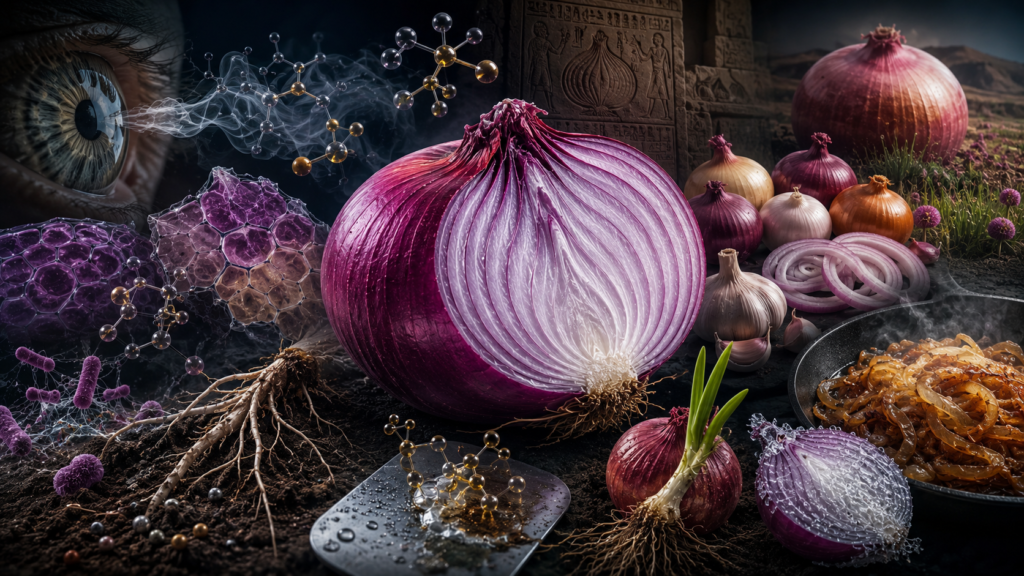
Discover 18 surprising facts about onions—from the science behind your tears and their hidden chemical defenses to their unusual growth, pigments, cooking chemistry, historical significance, and remarkable abilities. Explore the fascinating biology and chemistry hidden inside this everyday vegetable.
1. Why Do Onions Make You Cry?
Cutting an onion triggers a remarkable chemical defense system. When its cells are damaged, enzymes act on sulfur-containing compounds and ultimately produce a volatile irritant called syn-propanethial-S-oxide. This compound reaches your eyes and contributes to irritation that triggers more tears. In other words, the onion is activating a chemical defense system that makes your eyes respond.
The surprising part: Your tears are actually part of your eyes’ natural defense response to the onion’s chemistry.
Source: An onion enzyme that makes the eyes water — Nature
2. The Onion Is Secretly a Survival Battery
An onion bulb is essentially a food-storage organ for the plant. It stores carbohydrates and other nutrients that provide energy when the plant needs to survive unfavorable conditions and later produce new growth. When an onion begins sprouting, the developing leaves use these stored resources to grow—even before the plant has established a large photosynthetic leaf system. What looks like an ordinary kitchen vegetable is actually a compact biological survival package.
The surprising part: The onion you eat is storing energy for the plant’s future growth.
3. Every Onion Has Invisible Chemical Weapons
An onion has a sophisticated chemical defense system that activates when its tissues are damaged. Cutting or chewing the bulb allows enzymes and sulfur-containing compounds to interact, producing pungent chemicals that can discourage insects, microbes, and animals from feeding on the plant. These compounds are part of the onion’s natural defense strategy, helping protect its tissues from biological threats.
The surprising part: That strong onion smell and sharp taste are partly the result of a built-in chemical defense system.
Source: An Appraisal of Developments in Allium Sulfur Chemistry — Molecules
4. Onion Rings Are Actually Modified Leaves
Those concentric rings aren’t just decorative layers. An onion bulb is made largely from thickened leaf bases packed tightly around a very short stem. These fleshy leaf bases store nutrients that the plant can later use for growth. So when you cut an onion and see its familiar rings, you’re actually looking at layers of modified leaves arranged around the plant’s growing point.
The surprising part: The onion bulb is not a root—it is mainly a compact storage structure built from modified leaves.
5. Onions Can Take Up Heavy Metals From Polluted Soil
Onion plants can absorb certain heavy metals, including elements such as cadmium and lead, from contaminated soil and accumulate some of them in their tissues. This characteristic has made Allium cepa useful in research involving environmental pollution and biological monitoring. But it also highlights why growing edible crops in contaminated soil can create a food-safety concern.
The surprising part: An onion plant can respond to and accumulate pollutants from the soil—but that does not make contaminated crops safe to eat.
6. Purple Onions Have Natural Cell-Protecting Pigments
Purple onions get much of their deep red-purple color from anthocyanins, a group of plant pigments with antioxidant activity. These compounds help plants respond to environmental stress and can contribute to the onion’s antioxidant properties. Their concentration can vary with onion variety and growing conditions, which is one reason purple onions can differ noticeably in color intensity.
The surprising part: The vivid purple color isn’t just decoration—it comes from biologically active pigments produced by the plant.
7. Why Do Onions Smell Stronger After Cutting?
An intact onion keeps many of its enzymes and sulfur-containing molecules separated inside different parts of its cells. Cutting destroys those cellular compartments, allowing the chemicals to mix and triggering rapid enzymatic reactions that produce volatile sulfur compounds. These compounds escape into the air, making the freshly cut onion smell much stronger than an intact one.
The surprising part: Cutting an onion doesn’t simply release its smell—it triggers chemical reactions that produce many of the volatile compounds responsible for that smell.
Source: Investigation of Volatiles Emitted from Freshly Cut Onions — PMC
8. Why Were Onions Important to Ancient Egyptians?
Onions were an important part of ancient Egyptian life, appearing in food, art, and funerary contexts. Archaeological evidence shows onions among food offerings and depictions associated with ancient Egyptian tombs. Their distinctive layered structure may also have contributed to later interpretations of symbolic meaning, although the specific symbolism should not be treated as universally established.
The surprising part: Thousands of years ago, this ordinary vegetable was important enough to appear in ancient Egyptian funerary and artistic contexts.
Source: Ancient Egyptian tomb relief featuring onions — Smithsonian Institution
9. Onions and Garlic Are Close Relatives
Onions and garlic belong to the same plant genus, Allium, which also includes leeks, shallots, and chives. Their characteristic pungent aromas and flavors come largely from sulfur-containing compounds that are produced when their cells are damaged. So the distinctive smell of both onion and garlic comes from related chemical systems inherited from close botanical relatives.
The surprising part: Onions and garlic may taste different, but much of their characteristic chemistry comes from the same botanical family.
Source: The analysis of onion and garlic — PubMed
10. Some Onions Are Sweeter Than Others
Onion flavor depends on a balance between sugars and pungent sulfur compounds. Variety, growing conditions, soil, temperature, and maturity can all influence this chemistry. Onions with more sugars and fewer pungent sulfur compounds generally taste milder and sweeter, while others produce a much sharper bite.
The surprising part: An onion’s sweetness isn’t determined by sugar alone—the balance between sugars and sulfur compounds shapes its overall flavor.
Source: Characterization of Shortday Onion Cultivars of 3 Pungency Levels — PubMed
11. Can Onions Kill Bacteria?
Laboratory studies have found that certain onion extracts and their sulfur-containing compounds can inhibit the growth of some bacteria. However, these findings do not mean that eating onions can treat bacterial infections. Antimicrobial activity observed in laboratory experiments is different from a proven medical treatment in humans.
The surprising part: Onion compounds can show antimicrobial effects in the laboratory, but onions are not a substitute for antibiotics or medical treatment.
Source: In vitro antibacterial activity of onion against clinical isolates of Vibrio cholerae — PubMed
12. Why Do Chilled Onions Reduce Tears?
Chilling an onion before cutting it is commonly reported to reduce tearing because lower temperatures can slow the enzyme-driven reactions involved in producing volatile irritating compounds. Cooling does not stop the chemistry completely, and the size of the effect can depend on the onion and cutting conditions.
The surprising part: A simple chill may slow some of the onion’s tear-producing chemistry before you start cutting it.
Source: Why Onions Make You Cry — Serious Eats
13. The World’s Heaviest Onion Weighed 8.97 Kilograms
Some onions can grow to astonishing sizes under carefully controlled growing conditions. The current Guinness World Records record is 8.97 kilograms, achieved by Gareth Griffin in the United Kingdom in 2023. Reaching such enormous size depends on genetics, variety, growing conditions, nutrition, water supply, and a long growing period.
The surprising part: A single onion can grow to a weight greater than a typical bowling ball.
Source: Heaviest onion — Guinness World Records
14. Onions Change Flavor When Cooked
Cooking transforms an onion’s flavor through heat-driven chemical reactions. As the onion heats, some pungent sulfur compounds break down or are lost, reducing its sharp bite. At the same time, water is lost and naturally occurring sugars become more concentrated; with sufficient heat, browning reactions create additional complex flavors, producing the characteristic sweet, rich taste of cooked onions.
The surprising part: Cooking doesn’t simply make onions sweeter—it changes their chemistry, reducing pungency while creating a much richer flavor.
Source: Change in organosulfur compounds in onion during heat treatment — PMC
15. Wild Onions Helped Humans Find Food in the Past
Wild onions and other edible Allium plants have been gathered and eaten by people for thousands of years. Their edible bulbs, leaves, and flowers provided nutrients and distinctive flavors in traditional diets. Archaeological evidence from North America shows that wild onion bulbs were gathered and consumed by prehistoric communities.
The surprising part: Long before modern agriculture, wild relatives of today’s onions could provide people with an accessible source of edible plant food.
Source: Wild Onion — Texas Beyond History
16. Why Do Onions Sprout at Home?
An onion bulb is still a living plant structure after harvest. When it encounters suitable moisture, temperature, and other environmental conditions, its dormant growing tissues can become active and send out new green shoots and roots. The developing sprout initially relies heavily on nutrients stored inside the bulb to support this new growth.
The surprising part: A sprouting onion isn’t simply spoiling—it is a living plant waking up and using its stored food to grow again.
Source: Physiological, biochemical and transcriptional analysis of onion bulbs during storage — PMC
17. Why Can Sulfur Compounds Make Silver Turn Black?
Onions contain sulfur-containing compounds, and sulfur chemistry is also responsible for the familiar dark tarnishing of silver. When silver reacts with sulfur-containing compounds or gases under suitable conditions, it can form silver sulfide, a dark compound that appears as black tarnish on the metal’s surface. The chemistry is well established, although the extent to which an ordinary onion directly tarnishes silver depends on the conditions.
The surprising part: The sulfur chemistry associated with pungent substances can contribute to the black tarnishing of silver.
Source: Silver to Black — Journal of Chemical Education
18. The Biggest Secret: Onions Are Modified Leaves, Not Roots
An onion bulb is mainly a swollen storage structure formed from the thickened bases of modified leaves surrounding a very short stem. These fleshy layers store carbohydrates and other nutrients that fuel future growth. The roots grow from the basal plate underneath the bulb, which is why the onion you eat is botanically very different from a root such as a carrot or radish.
The surprising part: The onion bulb isn’t a root at all—it’s a tightly packed storage structure made largely from modified leaves.
Source: Physiological, biochemical and transcriptional analysis of onion bulbs during storage — PMC
Conclusion
An onion may look like one of the simplest vegetables in your kitchen, but its biology tells a very different story. Its layers store energy, its cells manufacture defensive chemicals, its pigments create vivid colors, its chemistry changes when cut or cooked, and its bulb can remain alive long after harvest. The next time you cut an onion, you’re not just preparing food—you are interacting with a remarkably sophisticated plant structure.