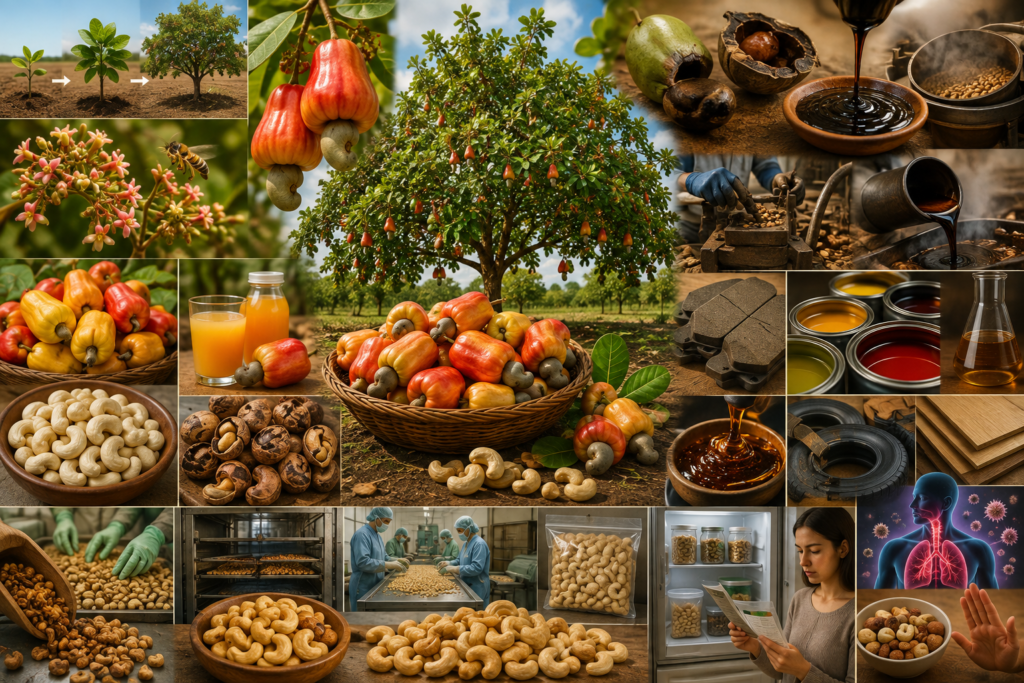
Cashews are one of the most popular dry fruits in India, but the food we casually eat hides some surprisingly unusual facts. From the strange structure of the cashew fruit to the dangerous liquid inside its shell, cashews have a story that goes far beyond their taste.
1. Cashew trees can start producing nuts surprisingly early
A cashew tree can begin producing nuts as early as its third year after planting. According to the Food and Agriculture Organization (FAO), full yields are generally reached around eight to ten years after planting. FAO
2. The cashew shell contains a dangerous liquid
Between the outer shell and the edible kernel is cashew nut shell liquid (CNSL), a chemical-rich substance containing phenolic compounds. It is corrosive and can cause skin irritation, which is why cashew processing requires careful handling. FAO
3. The “cashew nut” is actually the seed
The part we call a cashew nut is botanically the seed. It develops beneath the fleshy structure commonly called the cashew apple. Inside the seed is the edible kernel that we normally eat. FAO and ICAR
4. Cashew shells can contribute to automobile brake materials
The liquid obtained from cashew shells is not simply agricultural waste. CSIR-NIIST documents CNSL applications in friction linings, while FAO specifically identifies cashew shell liquid as a raw material for brake-lining compounds. CSIR-NIIST and FAO
5. The cashew apple is highly perishable
The fleshy cashew apple deteriorates quickly after harvesting, which makes long-distance transportation and storage difficult. This is one reason consumers in places far from major cashew-growing regions rarely encounter fresh cashew apples. FAO
6. Cashew apple can contain remarkably high vitamin C
FAO material reports about 240 milligrams of vitamin C per 100 grams of cashew apple, compared with about 45 milligrams in the citrus examples cited there. Actual values can vary with variety and growing conditions. FAO
7. Bees can be important to cashew production
Cashew flowers depend on pollinating insects. Research from India has identified bees, including the giant honey bee Apis dorsata, as important cashew pollinators, linking pollinator activity with fruit and nut production. Research study
8. You should not open freshly harvested cashews and eat them like peanuts
A freshly harvested cashew still inside its shell is not equivalent to the shelled cashew sold in shops. The shell contains irritating and corrosive substances that must be dealt with during processing. Industrial processing uses controlled treatment before the edible kernel is separated. USDA Agricultural Research Service
9. The cashew apple is edible but remains underutilized
The cashew apple is not merely a discarded part of the plant. It can be processed into products such as juice and pulp. ICAR has been actively developing technologies and training programmes for cashew-apple processing and value addition to reduce post-harvest losses. ICAR
10. Cashew harvesting can require considerable manual labour
Cashew harvesting involves collecting mature nuts, often after they have fallen naturally to the ground, followed by drying and further processing. Traditional harvesting and processing therefore require substantial human labour. FAO
11. Cashew can tolerate drought and relatively poor soil
Cashew is a relatively hardy tropical crop. FAO describes it as tolerant of drought and poor soil, although adequate moisture and good management are still important when the goal is high commercial production. FAO
12. India imports raw cashews despite being a major producer
India has a large cashew-processing industry, but domestic production has not always been sufficient to meet the industry’s demand for raw cashew nuts. ICAR has highlighted India’s dependence on imported raw cashews and the need to increase domestic production. ICAR
13. Cashew trees are commonly propagated through grafting
Because cashew is cross-pollinated, seedlings can differ in yield, nut size, fruit characteristics and other traits. ICAR therefore recommends vegetative propagation, including softwood grafting, to produce genetically uniform plants with earlier and more predictable fruiting. ICAR
14. Refrigeration can help extend cashew storage life
Cashew kernels contain considerable fat, so storage conditions matter. FAO recommends suitable airtight packaging and reports that properly stored processed cashews can remain stable for extended periods, with refrigeration useful for longer-term preservation. FAO
15. Cashews are particularly rich in dietary copper
According to the U.S. National Institutes of Health, one ounce, approximately 28 grams, of dry-roasted cashews provides about 629 micrograms of copper, equivalent to approximately 70% of the Daily Value used in the U.S. nutrition system. NIH Office of Dietary Supplements
16. “Raw cashews” are not completely untreated
The word “raw” on commercially sold cashews can be misleading. USDA food-composition documentation explains that cashews marketed as raw have already undergone heat treatment to safely remove the kernel from the shell; they simply have not been additionally roasted for flavour. USDA Agricultural Research Service
17. Cashew-shell chemicals have applications far beyond food
CNSL and its derivatives are used as renewable industrial raw materials. CSIR-NIIST lists applications including friction linings, paints, varnishes, laminating resins, rubber-compounding resins, polyurethane polymers and epoxy resins. CSIR-NIIST
18. Cashew allergy can be serious
Cashew is a recognized food allergen, and allergic reactions can be severe in some people. USDA Agricultural Research Service research has identified several cashew allergens and has investigated how processing affects their properties. People with a known cashew allergy should avoid cashews and carefully check packaged-food ingredients and allergen information. USDA Agricultural Research Service
Why these facts matter
Cashews are much more than a popular dry fruit. Their unusual fruit structure, hazardous shell liquid, complex processing, nutritional composition, agricultural requirements and industrial applications make them one of the more fascinating food crops. The next time you eat a handful of cashews, remember that the edible kernel is only one small part of a much more complicated biological and industrial story.
Important note
The information in this article is provided for educational purposes. Nutrition and food-safety information can depend on the product, preparation method and individual circumstances. For allergies, dietary restrictions or other health-related decisions, consult an appropriate qualified professional and verify information with authoritative sources.
Official Sources
Food and Agriculture Organization (FAO) — Cashew Nut
Indian Council of Agricultural Research (ICAR)
USDA Agricultural Research Service
U.S. National Institutes of Health — Office of Dietary Supplements
CSIR — National Institute for Interdisciplinary Science and Technology