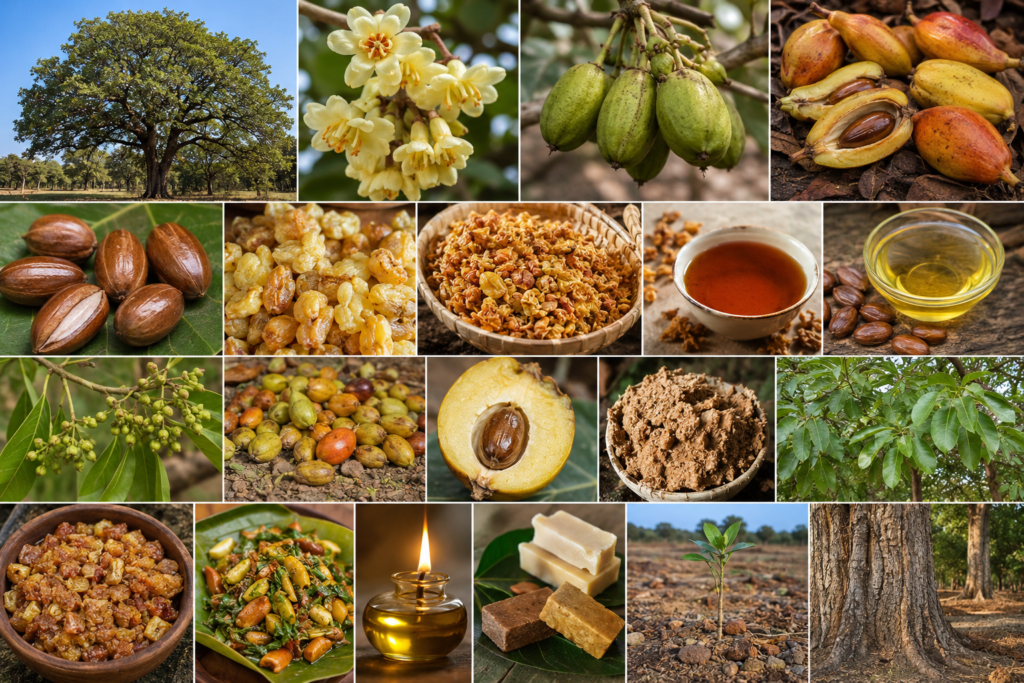
Mahua (Madhuca longifolia) is one of India’s most useful multipurpose forest trees. It belongs to the Sapotaceae family and is valued for its fruits, seeds, flowers, oil and other products. Government and forestry sources describe Mahua as an important species for food, fodder, fuel and local livelihoods.
1. Mahua Fruit Is Fleshy and Contains Oily Seeds
Mahua produces fleshy, greenish fruits. Inside the fruit are typically one to four shiny, brown and oil-rich seeds. The fruit and its seeds are therefore both biologically and economically important.
Official source: Indian Council of Forestry Research and Education (ICFRE) — Modern Nursery Techniques
2. Mahua Seeds Are Exceptionally Rich in Oil
Mahua seeds contain a high proportion of lipids. Research literature reports approximately 50–61% lipid content in the seeds. The extracted fat is commonly known as Mahua or Mowrah butter.
Source: National Institutes of Health, PubMed Central — Functional characteristics, nutritional value and industrial applications of Madhuca longifolia seeds
3. Mahua Seed Oil Has Many Practical Uses
Oil extracted from Mahua seeds has several traditional and industrial applications. Government sources document its use for cooking and lighting, while other forestry literature also describes applications such as soap-making and other non-food uses.
Official source: National Portal of India — Mahua — One District One Product
4. One Mahua Tree Provides Many Useful Products
Mahua is not simply a fruit tree. Its flowers, fruits, seeds, oil, leaves and wood all have documented uses. This makes it a classic multipurpose forest species.
Official source: Indian Council of Forestry Research and Education (ICFRE) — Cultivation of Selected Forest Tree Species
5. Mahua Flowers Are Naturally Rich in Sugars
Mahua flowers contain substantial amounts of naturally occurring sugars. Their sweetness makes them useful as a traditional food resource and also makes them suitable for fermentation.
Official source: Indian Council of Forestry Research and Education (ICFRE) — Cultivation of Selected Forest Tree Species
6. Mahua Flowers Have Food Uses
Mahua flowers are traditionally eaten in several regions. ICFRE documents their use as food and describes their nutritional contribution, including carbohydrates, minerals and vitamins.
Official source: Indian Council of Forestry Research and Education (ICFRE) — Cultivation of Selected Forest Tree Species
7. Mahua Flowers Are Used for Traditional Fermented Beverages
Because the flowers contain fermentable sugars, they have traditionally been used to produce fermented and distilled beverages in parts of India. This is an important cultural and economic use of Mahua flowers.
Official source: National Portal of India — Mahua — One District One Product
8. Mahua and Chikoo Belong to the Same Botanical Family
Mahua belongs to the family Sapotaceae. Chikoo, commonly known botanically as sapota, also belongs to Sapotaceae. So although the two fruits look different, they share a botanical family.
Official source: Botanical Survey of India — Floristic and Ethnobotanical Studies
9. Mahua Seeds Are Surprisingly Large
Mahua seeds are elongated, brown and shiny. Published botanical descriptions report seeds around 2 centimetres long, making them a substantial part of the fleshy fruit.
Source: National Institutes of Health, PubMed Central — Madhuca longifolia seed research
10. Mahua Is a Deciduous Tree
Mahua naturally sheds its leaves as part of its seasonal cycle. ICFRE describes it as a medium-sized deciduous tree with a broad crown.
Official source: Indian Council of Forestry Research and Education (ICFRE) — Modern Nursery Techniques
11. Mahua Leaves Can Be Used as Fodder
Mahua leaves have fodder value. Forestry sources document their use for cattle and other livestock in several Indian regions.
Official source: Indian Council of Forestry Research and Education (ICFRE) — Cultivation of Selected Forest Tree Species
12. The Leftover Seed Cake Can Be Used as Manure
After oil is extracted from Mahua seeds, the remaining seed cake is not necessarily waste. ICFRE documents its use as manure, either alone or together with other fertilizers.
Official source: Indian Council of Forestry Research and Education (ICFRE) — Cultivation of Selected Forest Tree Species
13. Mahua Seed Cake Has Also Been Investigated for Wastewater Treatment
Research has investigated Mahua seed-derived material for removing certain dyes from wastewater. This is a research application and should not be interpreted as meaning that Mahua seed cake makes all contaminated water safe to drink.
Research source: National Institutes of Health, PubMed Central — Functional characteristics, nutritional value and industrial applications of Madhuca longifolia seeds
14. Mahua Contains Several Bioactive Plant Compounds
Scientific studies have identified compounds associated with Mahua, including saponins, flavonoids, triterpenoids, steroids and glycosides. Researchers have investigated these compounds for various biological activities.
Research source: National Institutes of Health, PubMed Central — Phytochemical research on Madhuca longifolia
15. Researchers Are Studying Possible Biological Activities
Some Mahua compounds have demonstrated biological activity in laboratory research, including antioxidant-related, anti-inflammatory-related and antimicrobial effects. These findings should be described as research observations rather than proof that eating Mahua treats disease.
Research source: National Institutes of Health, PubMed Central — Madhuca longifolia phytochemical research
16. Mahua Fruit Is Edible
Government forestry documentation records Mahua fruits as edible and notes that they may be eaten raw or cooked in traditional use. The exact culinary preparation varies by region.
Official source: Government of Maharashtra, Forest Department — Forest Department Working Plan
17. Mahua Is Important for Rural and Forest-Dependent Livelihoods
Mahua flowers, fruits and seeds can be collected, consumed, processed or sold. Because several parts of the tree have economic value, Mahua has long been important to communities living in and around India’s forests.
Official source: National Portal of India — Mahua — One District One Product
18. Mahua Is a True Multipurpose Tree
Perhaps the most remarkable fact about Mahua is how many different resources can come from one tree. Its flowers provide food and traditional beverage ingredients, its fruits and seeds provide edible resources, its seeds yield oil, its leaves can serve as fodder, seed cake can be used as manure, and its wood has construction and fuel applications.
Official source: Indian Council of Forestry Research and Education (ICFRE) — Cultivation of Selected Forest Tree Species
Conclusion
Mahua is far more than an ordinary wild fruit. From its sweet flowers and edible fruits to its oil-rich seeds and useful seed cake, different parts of the tree support food, traditional practices, agriculture and local livelihoods. Its remarkable versatility explains why Mahua remains such an important indigenous tree in India.
Sources
- Indian Council of Forestry Research and Education (ICFRE) — Modern Nursery Techniques
- Indian Council of Forestry Research and Education (ICFRE) — Cultivation of Selected Forest Tree Species
- National Portal of India — Mahua — One District One Product
- Botanical Survey of India — Floristic and Ethnobotanical Studies
- Government of Maharashtra, Forest Department — Forest Department Working Plan
- National Institutes of Health / PubMed Central — Functional characteristics, nutritional value and industrial applications of Madhuca longifolia seeds
Editorial note: Traditional uses and laboratory findings should not be interpreted as established medical treatments. Scientific evidence varies by preparation, dose and experimental setting.